Brianna wins the Ring rookie battle
On the Come UpBrianna wins the Ring rookie battle, the Rookie Royale, by turning a frightening first appearance into a public declaration of skill and authorship. Her victory over Milez launches her reputation as a rapper, but the battle’s deeper significance lies in the tension it sets in motion: people will hear her performance as a role, a threat, or a marketable image, while Brianna struggles to make it unmistakably her own.
Background and Stakes
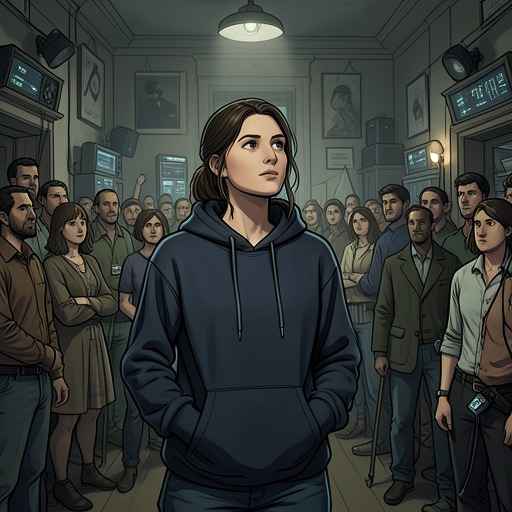
The Rookie Royale is announced at the Ring as a first-time contest between two rookies. Brianna has watched Ms. Tique win her first two battles decisively, and the crowd’s response makes the event feel like a place where words can command immediate attention. When Hype calls Brianna’s name, Aunt Pooh raises her arm and leads her forward, proclaiming her the champion before she has performed. Brianna is frightened rather than assured: hundreds of people watch from around the Ring, phones pointed toward her, and she knows that losing will be remembered.
The contest also brings a particular pressure of representation. Brianna is a young woman entering a rap battle in which she expects to be doubted and judged against standards shaped by men. Aunt Pooh has warned that she will have to work twice as hard for half the respect, be as ruthless as the men around her, and avoid showing weakness. At an earlier encounter with dismissive men, Brianna answers a joke about nursery rhymes with a pointed insult; their laughter and approval briefly let her join their circle. The battle makes that demand more public: she must prove her ability without letting the audience define what kind of rapper she is allowed to be.
The Battle and the Turn
Brianna enters the contest despite her fear. Before the battle, she sees that Milez talks confidently but appears afraid, a contrast that gives her an opening. When the beat begins, however, her prepared lines vanish. The sudden blankness threatens to turn the anticipated performance into failure, and the battle’s outcome is uncertain even to Brianna. Instead of retreating, she begins to build her response in the moment, finding a flow as the music continues.
Her first extended attack challenges Milez’s credibility. She accuses him of relying on a writer, contrasts his borrowed rhymes with her own ability, and turns his image into a target for the crowd. The performance escalates from personal taunting to a claim on the Ring itself: Brianna presents herself as the future and Milez as an act whose reputation cannot withstand scrutiny. The crowd rises with her, and Aunt Pooh celebrates from the ropes, but Brianna still has to face the judges’ vote.
In the final round, Brianna continues rather than resting on the audience’s excitement. Her verses ridicule Milez as a pop star rather than a rapper, mock his boasts about clothes, shopping, and weapons, and insist that his ghostwriters could not anticipate her attack. The writing turns the contest’s central question—who has the right to claim the title of rapper—into a question of authorship. Brianna is not merely trying to win a vote; she is demonstrating that she can make the words and control the performance herself.
Verdict and Immediate Consequences
The judges split at first: Mr. Jimmy and Dee-Nice choose Brianna, while CZ chooses Li’l Law. Hype announces the winner only after that divided vote, raising Brianna’s arm as the crowd cheers. The victory is therefore not presented as effortless unanimity. It follows a moment of suspense and a close decision, making the result both a recognition of her performance and a public break from the expectation that she is an unknown who can rap but cannot yet command the Ring.
The event changes Brianna’s standing. The battle is recorded and later becomes something Hype urges listeners to find online, while her performance is repeatedly cited as evidence of her talent. The visibility that follows is double-edged: the same public attention that makes her a rising artist also gives strangers material to interpret, circulate, and reframe. Her success does not grant her control over every account of what she means.
From Performance to Public Identity
Later, a Crown notices Law’s chain and recognizes Brianna as Lawless’s daughter. That encounter shows how the battle’s new visibility exists alongside an older, inherited identity tied to her father and the neighborhood. Brianna’s own performances are also drawn into public narratives beyond the Ring. When news coverage presents her song “On the Come Up” as violent and popular among young listeners, a broadcaster focuses on lyrics about weapons and law enforcement; Brianna objects that the protest being discussed had reasons the coverage has ignored. The fight over interpretation echoes the battle’s demand that she establish herself, but now the audience includes media outlets and listeners who can detach words from their context.
The distinction between performance and identity becomes explicit in Brianna’s later conversations with Hype and Supreme. Hype challenges her lyrics because a sixteen-year-old girl is rapping about being armed, while Brianna points out that her father rapped about such subjects at sixteen without prompting the same concern. Supreme advises her to play the role people expect and explains how he uses others’ assumptions to succeed in the music business. He also reveals that he once pushed Law toward a street image, including association with the Garden Disciples, to make him appear authentic; Law took that image seriously. Supreme urges Brianna not to repeat her father’s path, but his advice still treats identity as something to manage for an audience and a market.
Authorship and Significance
That pressure becomes concrete when Supreme argues that Brianna should record a song written by Dee-Nice. He frames the choice as business and money, invoking the family’s need and even offering to make the song’s image seem more authentic. Brianna rejects the idea that success justifies surrendering authorship. The battle’s insistence that Milez depends on ghostwriters thus develops into a larger question: whether Brianna can enter the industry without becoming a manufactured version of the figure others expect.
In a later performance, Brianna answers that question by refusing to be a puppet, a clone, or a symbol that others can sell as truth. She identifies herself as someone’s daughter, sister, hope, and mirror, and distinguishes speaking about what she sees from claiming that violence defines her. Her closing insistence that she is not for sale turns the battle’s victory into a beginning rather than a resolution. The Rookie Royale proves Brianna can command a crowd; the larger arc tests whether she can keep command of her words after the crowd, the media, and the industry begin telling her what those words mean.